Immigrants–How the Melting Pot Used to Work

In my recent novel, Growing Up Tough, I weave stories my father told about his childhood in a small mining town in Utah during the twenties and thirties. A key theme is the interaction of various immigrant groups who had come there to work in the coal mines. They started as Greeks, Italians, and others, but they ended up as Americans. Here is Chapter One:

Chapter 1

Eddie

Eddie giggled as he nudged the big chestnut forward. Mother stood in front of him, head up and very straight and stern, but took a tiny step backward.

“Shirley Edwin Taylor,” she said, “You come down from there this instant!”

Eddie had found the horse wandering about the alley behind their lot. Carefully he had walked up to him, speaking softly and quietly until he could stroke his neck, being careful not to look him in the eye, not to spook him. He then pushed him over next to a trash can he could climb on to, and from there slid over to his back.

He hugged his new animal friend, buried his face in his thick neck and mane, and breathed deeply. There was that good smell of life. Eddie loved life. And this horse was a wonderful living creature.

Now that wonderful living creature towered over his little mother, who was less than five feet, even when she pulled herself up as straight and tall as she could.

He laughed more loudly. “Uh uh.”

The horse took another step forward and Mother stepped back again, one hand patting the hair that strayed from where it was gathered on the top of head.

She shook her finger at him. “I mean it. You are too small to be on such a big horse. You could fall off and break your neck. Come down!”

Eddie considered her demand. He loved Mother and tried to be a good boy, but he knew her fear of horses. This was just too much fun to resist. The horse snorted, flicked its ears, and pawed the ground a little.

“Uh uh.”

Before she could stamp her feet and speak again, Father came out the back door, suppressing a smile. He strode over to the horse, reached up, and pulled the five year old down. “Come along young man. I want you to go with me. And stop teasing Mother.”

He looked at the horse, made a clicking sound, and said, “Go home.” The horse ambled away toward the alley.

He then swatted Eddie on the bottom, squeezed Mother’s arm, and said, “I’m going over to Anderson’s office to watch the strike. Taking Johnny and Junior too. We’ll be home in time for supper.”

“He deserves more than a swat for that. He could have been hurt.”

“I’ll take care of it,” Father said as he headed around the side of the house to the front yard.

Eddie’s older brothers were waiting for them. They shared the prominent nose, sharp features, and natural spunk that were typical of the Taylors.

“Follow me, boys. We’re going the back way.”

They struggled to keep up with their father, who always walked briskly. As they crossed the side streets they peeked to the south where in the distance they could glimpse Main Street. It was filled with people. Some carried signs, some stood, others milled about. There were loud voices, but Eddie could not make out what they were saying.

From Sixth Street they went east past the construction site of the new Roman Catholic Church, around the back of the Mormon Tabernacle, across the gravel play yards, behind the City Office Building, to the back entrance of the Carbon County Courthouse, a big double door beneath a portico with square pillars.

Eddie’s eyes widened. A soldier with rifle and bayonet stood guard by each pillar; they stiffened a little as the man and his sons approached. Behind them a sheriff’s deputy leaned against the door frame. He tipped his hat and waved them on, saying to the guards, “It’s okay, boys. They’re friends of Judge Anderson.”

“Hi there, Carl. ‘Come to see what happens, huh. Go on up, there’s a crowd gathering.” They hurried up the back staircase, avoiding the county staff and officials and reporters milling in the foyer to hear what was going on.

The second floor judge’s office had a large window that looked out on Main Street. About a dozen people were in the room, alternately looking out at the street or passing back and forth into the hall to the other offices. The transom window was open so they could hear the voices outside.

 Judge Anderson was older than Father, with a sprinkling of grey in his hair and cheery smile wrinkles around his eyes. He stuck out his hand and shook Father’s. “I am glad you could join us, Carl, and I see you brought your boys.”

“Yes. These are Junior, Johnny, and Shirl.”

“Call me Eddie,” piped up the youngest.

“Mind your manners! He prefers Eddie, from his middle name. I thought it would be good for them to see a little history in action. They might remember it later.”

The Judge laughed. The man next to him snorted and said, “History! Bunch of nonsense by a bunch of troublemakers. They did the same thing in ’03.”

Judge Anderson laughed again, “Carl, you probably haven’t met Fred yet; he’s County Clerk and Town Cynic. Carl just moved here from Provo.” Fred was short, shorter than Dad, thin, and quite a bit older. His skin was tanned and leathery. Anderson added, “Fred is a rancher when he’s not clerking. He has a spread out north of Castle Gate. ‘Doesn’t think much of miners.”

“Oh, nice country,” said Father. “I go out there for customers.”

“Carl is in the wholesale grocery business. He also manages the old Scowcroft warehouse over on the southside,” the Judge added. “He’s Karl Karlson’s new boss.”

“Carl and Karl. Nice to keep things simple.”

“Yeah. He’s Karl with a K. I’m Carl with a C.”

“Ah, that makes it easier.”

“My territory goes out to the Ute reservation and Roosevelt; I cover much of the eastern and northeastern parts of the state.”

“Must be a lot of travel.”

“At times. Life’s a lot easier now with telephones, when people have ’em. Unfortunately, a lot of my customers do not. I spend a lot of time in town at the warehouse too.”

Loud voices from Main Street interrupted the conversation. Eddie stretched to see.

The town of Price was platted with very wide streets, large blocks, and large lots. Main Street ran from East to West parallel to lettered strees, with crossing numbered streets from the train tracks in the west eastward. Now that large Main Street in front of the Carbon County Courthouse was filled with people for as far as Eddie could see.

Most were men in work clothes, not very clean looking, the coal dust permanently staining them. Like nearly all men in 1922 they wore hats–homburgs, bowlers, newsboy caps. No fedoras like father’s, and no cowboy hats, which was disappointing for Eddie, who had understood they were moving to Cowboy Country when they left Provo. Then again, these were mostly foreigners.

Shirts were buttoned right up to the top and had long sleeves. There were very few ties. Grown men usually wore ties, but most of these miners did not. Almost all the men had dark hair, with mustaches, and a few beards. And they all had unhappy, angry expressions. One authoritative voice rose over the others.

“I want to assure you, we are giving every consideration to each of the complaints we have received. The governor and the mine owners are meeting with leading individuals in the mining community. But nothing will be accomplished by marching around here this afternoon.”

Eddie craned his neck to see where the voice was coming from. It belonged to a man standing beneath the portico in front of the courthouse to the right of Judge Anderson’s window. He was distinguished looking, with a large round belly, and dressed in a suit with black top hat. All the officials wore top hats.

About this time the whistle blew; it was one o’clock. The whistle was at the steam laundry and blew every day at 8 am, noon, 1 pm, and 5 pm. This was convenient since it helped people keep track of time and stay on schedule. Coming now, though, it caused a stir in the crowd, startling a little at first, then just nervous shifting of weight and more milling around.

It was then that Eddie noticed the machine guns.

Thirty or more soldiers with rifles and bayonets were on either side of the portico, with more right behind the speaker. In front of the right and left pillars were machine guns secured behind sandbags, with soldiers manning them, hands on handles. They looked grim, and nervous.

Looking back to the crowd in the street, Eddie saw that most of the men had a pistol at the side or were carrying a rifle or shotgun.

“Old windbag,” muttered Fred with a scowl,nodding toward the speaker in front. “It’s all the Italians’ fault. ‘Bunch of Bolsheviks. Anarchists. They oughta just clear ’em out.”

“Well,” added Anderson, “it did start with them, but now the Greeks have joined in, which is a bit of a surprise and a disappointment to me. I didn’t think they would.”

“They’re troublemakers too. The refuse of Europe. And it’s not the miners I mind, at least not as such. It’s the blasted immigrants.” Fred thought a moment. “Well, not immigrants really. Mother’s family came over from Ireland not so long ago. It’s just this lot, they’re full of communists, want to do the same thing here they did in Russia.”

“That’s a bit of a stretch, Fred,” replied the judge.

“Listen, if they can take down a czar, they can take down a president too.”

“Getting carried away, Fred.”

Fred sighed, “Oh, I don’t know. What I do know is they started coming too fast. It takes time to turn ’em into Americans. ‘Takes time for the stuff in the pot to melt.”

“Huh?”

“You know, the ‘melting pot’. It takes time for them to not be foreigners anymore and start thinking like Americans.”

“You have a point there, Fred.”

Father asked, “What are they striking about?”

“Wages, mostly. They were cut when the price of coal fell after the war. And working conditions–they are bad, especially living conditions in the camps. They want improvements in the company houses–but I don’t see how they can be made any better without a lot more money than the companies can spare. And they want a union, the UMWA.” He looked over at Father. “Have you been in the mining camps?”

“Drove past. Didn’t see much. I don’t have many customers there.”

“The companies own it all. They rent the houses to the miners and their families and sell them everything they need at the company stores. Oh, and don’t get me wrong, there are a lot of good things about the camps–ball fields, dance halls, theaters, schools, churches. Lot’s to do to keep people happy. It’s just the homes that need improvement, especially in winter.”

“That’s where it started,” said Fred. “That guy right there.” He pointed a bony finger at a young man in the front row of the crowd just below the portico. “Frank Bonnaci. The union sent him here as an ‘organizer’. More like Italian immigrant troublemaker.”

“Well, talk is one thing,” added Anderson. “Problem is, now there have been casualties on both sides. Some Italians were wounded, and Greeks shot a company guard and a sheriff’s deputy.”

“Yes. I read about it in the paper.”

“We have several in jail, but whether they are really the culprits–who knows? No one admits anything.”

Fred’s face brightened. “Did you say your name is Taylor? Are you the son of Alfred Taylor? I knew your father. A good judge. Straight shooter.”

He looked out at the crowd again. “He would have known what to do with a mob like this. He spent most of the war chasing Quantrill in Kansas, you know.” He meant the Civil War.

“Yes, I know.” Being the son of Judge Alfred Taylor meant automatic acceptance into the social and political leadership circles of the state, at least those that were Republican. It had counted for a lot in Provo, but not so much in Price, where Democrats were the majority.

Another man ambled into the office, square jaw, straight shoulders, and sandy brown hair, about Fred’s age. He wore a fedora like father’s only a lighter shade of tan. And he wore there was a star on his shirt.

“Matt Warner,” said Anderson, “good to see you.” They exchanged pleasantries and introductions.

“Matt is a justice of the peace and deputy sheriff. He usually hears civil disputes and juvenile cases.” He cast an eye at Eddie and his brothers. “Stay out of trouble!” The boys’ eyes widened. The judge turned away to smile. “But it wouldn’t hurt to get acquainted with him in any case. He spins a great yarn.”

“Nothin’ but the truth,” insisted the deputy.

The adults turned back to politics, but Eddie kept glancing at Warner. There was something about him that was interesting. Eddie was not sure what it was. He seemed a little different from the other men in the room, jovial, yet at heart very serious, and a little sad. Eddie thought he had a rough edge to him. Finally it occurred to him that Warner reminded him of the cowboys he had seen at the movies, sort of like Fred the rancher and Town Cynic, only more so. Sort of like what’s his name in The Great Train Robbery? Tom Mix. Neat name, thought Eddie.

Warner looked at the street a few minutes and grew quiet. “Mobs give me the willies. Maybe ’cause most of the ones I’ve seen, they were after me. These fellas’ look a lot like a bunch that surrounded me in Ellensburg. Only they had ropes.”

Anderson chuckled, “I remember your telling me about that. If I remember right you talked your way out of it.”

“Yeah. I was pretty darn lucky. Problem with a mob, you cannot predict what it will do, except it’s usually nothin’ any good. It has a lot of emotion, but no brain.” He stared out the window a minute or two at the crowd milling about. “Looks like the mayor has plenty of help. I think I’ll go home.”

After he left, Anderson said quietly, “Matt is quite a character. A real cowboy. He’s a reformed bandit, you know, partner of Butch Cassidy. One of the more interesting people you will meet in our little town.”

“Aha!” thought Eddie. He was right. He looked over to where Warner had just left. Mobs had been after him–what did that mean? He looked a little harder at the crowd outside and marveled that so many people could get so upset. “A lot of emotion, but no brain”–that sounded important. Eddie tried hard to remember it.

There were only a few women, uniformly thin. Prominent cheekbones, hardly any muscle on their arms and no fat. If Eddie had known the word he would have called them gaunt.

There were only a few boys–no girls–standing close to men Eddie supposed were their fathers. One of the boys caught his eye, a boy about his age with jet black hair. The boy was staring back at him.

Synopsis of FBI Corruption

Joseph DiGenova is one of the nation’s premier lawyers. One of his recent speeches was published in the February issue of Hillsdale College’s Imprimis. This is an excellent review of the sorry state of the modern FBI leadership, not to be confused with the rank and file agents, most of whom must be pulling their hair at recent events. Well worth the read:

https://imprimis.hillsdale.edu/the-politicization-of-the-fbi/


Rules For Writers

It is generally good for a laugh to say that a professional writer has no rules. It’s not true, of course, and a number of great writers have made lists of rules which they follow with varying degrees of faithfulness. The lists might be summed up by saying that the One Great Rule of Writing is to communicate clearly. Therein lies the rub, for communication involves much more than conveying data from one brain to another; a laundry list can do that. Writers, especially fiction writers, have a host of associations connected to those data, ranging from subtle or not so subtle implications to the deepest emotions, and conveying those is a real challenge.

Available tools for that deeper and broader communication vary with the language, which partially accounts for the difficulty of translation. English has an especially wide vocabulary and variety of idioms to aid in the task (and to confuse the foreign learner). This is reflected in differences in style and usage from one English speaking country to another, American versus British for instance, and in changes over time; the writing of Hawthorne is strikingly different from Hemingway, or even Twain, though all worked in American English. Quite different products, each well communicated.

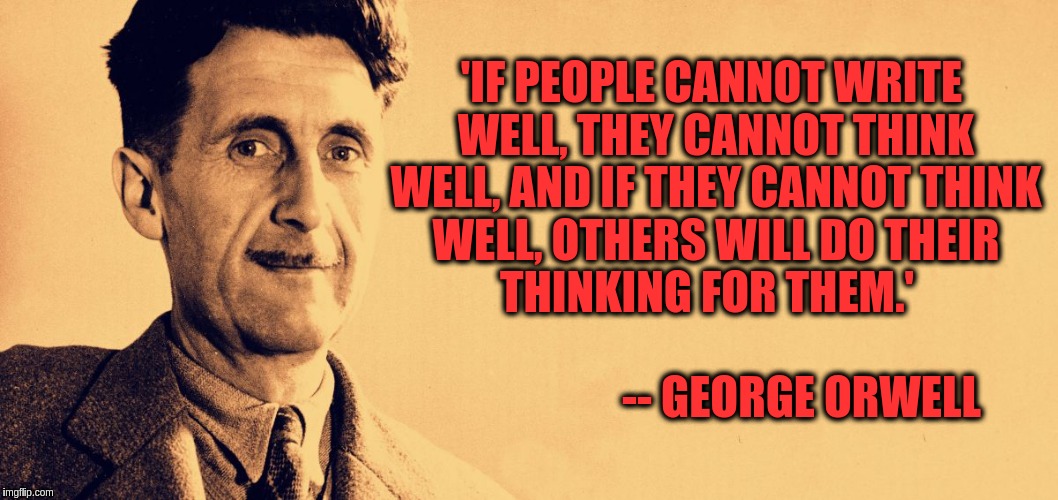
Orwell

I recently ran across an excellent discussion of the uses and abuses of language, specifically referencing political writing, authored by none other than George Orwell, one of the best writers of the 20th century. He includes some egregious examples which may evoke great groans of laughter. A link to his essay is below, but first, his list of rules:

  1. Never use a metaphor, simile, or other figure of speech which you are used to seeing in print.
  2. Never use a long word where a short one will do.
  3. If it is possible to cut a word out, always cut it out.
  4. Never use the passive where you can use the active.
  5. Never use a foreign phrase, a scientific word, or a jargon word if you can think of an everyday English equivalent.
  6. Break any of these rules sooner than say anything outright barbarous.

Good rules. Let us pledge to follow them more fully. And here’s that link:

http://www.orwell.ru/library/essays/politics/english/e_polit/


Best Wishes!

Education vs. Schooling


Years ago I published a quarterly newsletter called The Kithara. An article there pointed out the great damage done by Dewey and others when they changed education (satisfying the need of the individual for knowledge and understanding, thus creating useful and productive members of society who could think for themselves) into schooling (indoctrinating children in the current “progressive” dogma, thus creating obedient citizens who let their leaders think for them). The difference is profound.

30-Classic-Home-Library-Design-Ideas-8

An Ideal Home Library

From time immemorial, education has been the responsibility of the family and basics were taught by parents, including reading as well as principles of successful living, moral uprightness, and work.  This was supplemented with tutors and schools as opportunity and resources permitted. Reading and writing were recognized as necessary for communication and to have access to the scriptures, newspapers, and literature. An educated American in the 18th and 19th centuries was expected to be familiar with The Bible, Plutarch’s Lives, and Shakespeare. This system worked well enough that literacy rates at the time of the American Revolution are estimated at over 90%, and nearly 100% in Boston.

Education was a necessary precursor for the success of the American experiment in self-government. Recognizing this fact and the need to create good citizens, local governments instituted schools to better provide for children of families without the means to hire tutors or private schools; these were the public schools. They also functioned quite well for a long time, eventually becoming nearly universal, taking over many of the educational functions of families, and displacing private teachers. Despite the best efforts of generations of devoted public school teachers to aid and protect their pupils, politicians and ideologues recognized almost from the beginning that public schools with their naïve, captive audiences could be effective tools for indoctrination and social experimentation. In the process they necessarily devoted less and less time and resources to the actual acquiring of basic knowledge and useful skills. Alas!

1924 schoolroom

Elementary School About 1924

Chester Finn, a tireless champion of school reform for many years, recently wrote a fine article about the failure of one of those social experiments that started in the late 1980s and which even now corrupts discourse on the subject. It is well worth looking at:

https://edexcellence.net/articles/schools-are-still-peddling-the-self-esteem-hoax


Best Wishes!


Town and Country

Though born in a sizable city, Portland, Oregon, I am grateful to have been raised in the country. Even when we moved back to Portland while I was in Junior High School, it was not Portland per se, but a rural suburb. The sense of connection to the land and love for it that I grew up with have only been reinforced by the intervening years and travels. It is at least partly a sense of reverence and appreciation for God’s creations, but it is also an appreciation for the character that country life fosters. Like most things, this turns out to have political implications as well.

Victor Davis Hanson explored this concept in an essay linked below. It is well worth reading, not just for the political explanation, but also for the historical references:

http://www.city-journal.org:8080/html/trump-and-american-divide-14944.html

A New World Order

Niall Ferguson has published a brilliant and insightful essay on foreign policy in which the prospects for international order in our day are compared to those of Roosevelt. No, not that one, Teddy. Though long, it is well worth reading.

Donald Trump’s New World Order


Understanding Propaganda

The disgusting bias of the major news media in the recent election may give us pause to consider the difference between journalism and propaganda.

Those of a certain age will recall classes in school–yes, public schools–about how Nazis and Communists and other -ists manipulate their messages to mislead the masses. That was during the height of the cold war and was important so the American people could more easily discern truth from error. More recent generations have not been given such information, just as they have long since stopped hiding under desks during air-raid warnings.

In the end, all such tools, just as the -isms which use them, are means to a common end: the exercise of power by one group over another. This was one of the themes of my book, All Enlisted, and is perhaps the dominant theme of all history.

An excellent review of how journalism becomes corrupted follows:

http://thefederalist.com/2016/11/21/journalism-turns-propaganda/


Almost Election Eve

This election has become a bitter and desperate battle for survival of the most utterly corrupt figure ever to occupy the national stage and the so-called “elite” politicians, bureaucrats, lobbyists, media, and academics who support her. That includes a sizeable number of Republicans who care more about their perks and privileges than their duty and honor. You may not have wanted Trump as the leader of the charge against this cabal, but there he is, doing well and speaking right. We will hope for the best. Following is a quote from my book, The Federalist, Excerpts With Commentary, 2nd edition, first Madison, then my commentary:


LXXI. THE DURATION IN OFFICE OF THE EXECUTIVE

The tendency of the legislative authority to absorb every other, has been fully displayed and illustrated . . . The representatives of the people, in a popular assembly, seem sometimes to fancy that they are the people themselves, and betray strong symptoms of impatience and disgust at the least sign of opposition from any other quarter; as if the exercise of its rights, by either the executive or judiciary, were a breach of their privilege and an outrage to their dignity. They often appear disposed to exert an imperious control over the other departments . . .

(T)he best security for the fidelity of mankind is to make their interest coincide with their duty.


  1. Arrogance, the Imperial Congress, and the Imperial President

Congress has been particularly aggressive in expanding its power relative to the presidency following periods of presidential embarrassment such as after Watergate, during much of the Carter administration, and during the latter portions of the Reagan and first Bush administrations. This took on a partisan character because of long-lasting, one-party rule in the legislature. How then to explain the lack of congressional assertion of power during the remarkably expansive and repeatedly illegal actions of the Obama years? When controlled by the same party, they presumably agreed with him, but when controlled by the opposing party, why are there no concrete actions, special prosecutors, indictments, etc.? Does an unprecedentedly arrogant, Imperial President intimidate them? Or has Congress become so corrupt they simply want to stay at the trough and not “rock the boat”? Do their personal interests coincide with their duty?


Reasons For Trump

I grew up on stories of Abraham Lincoln and George Washington, Sir Walter Raleigh and Columbus, King Arthur and Sir Galahad. The highest ideal in life for a man is to be a Christian Gentleman, to emulate in our small lives the lives of great ones who have gone before us, most especially the greatest of all, our Lord Jesus Christ. So, when one of my grown daughters asked me after the recent release of that embarrassing 11 year old videotape of Donald Trump whether I still supported him for president, she might have been surprised when I answered, “yes”.

That was not to condone whatever was said on the tape–I have not and will not watch it, but the reports are enough. The fact is that though it has been many years since I was in a locker room, I remember how vulgar and uncouth some of the speech was. I was the quiet, nerdy guy, not one of the jocks who later became businessmen, lawyers, and politicians.

Through the years we have heard many stories and reports of similar embarrassing recordings of vulgar and uncouth language of leaders from FDR to Kennedy to Johnson to Nixon. Usually they are hidden by their friends in the media, unless their carefully timed release can sway an election toward the Democrat. And then, of course, they are all shocked, shocked at such language. Fact is, we are electing a president, not a Pope, and a vulgar and uncouth president may be all that a vulgar and uncouth people can handle.

There are four excellent reasons for voting for Trump:

First, we apply the Bill Buckley principle, “You should vote for the most conservative candidate who can win.” Trump is not a conservative, but he is infinitely better than Clinton, the most corrupt, vile, anti-Constitutional candidate in American political history. No third-party candidate can win.

Next, he has a remarkable talent for hiring good people such as Steven Moore as economic advisor. His lists of Supreme Court candidates, consultants, and supportive admirals and generals is a Whose Who of sensible, experienced, and constitutional thinkers and doers. He hires to his weakness, and is not reluctant to fire when necessary. (Incidentally, any previous Secretary of State would have resigned after the debacle in Libya; any previous President would have demanded it.)

Third, he is a disrupter. Not part of the political establishment and not beholden to the Establishment and their power brokers, he is committed to shaking up what has become an  utterly corrupt federal government which has usurped the powers and rights of the people and the states. His commitment to be the “law and order” candidate is refreshing, especially his most recent vow in last night’s debate to direct his Attorney General to appoint a Special Prosecutor to take action against Clinton for her many crimes. The fear you saw in her and her husband’s eyes when he spoke about it was real.

Finally, he has all the right enemies. Like a majority of my fellow Americans, I have grown to hate the fawning leftist media, the arrogant leftist academics, the violent leftist agitators, the complacent leftist bureaucrats, the rich leftist bankrollers, and the corrupt and haughty politicians of both parties they foist upon us. They call themselves “the Elite.” If they hate him, he has my vote.


Best Wishes.

Organized . . .

Will Rogers, the witty comedian and social commentator of the early 20th century, once remarked, “I do not belong to an organized political party. I am a Democrat.” What was funny then becomes less funny now as the nature of the modern Democrat Party’s organization becomes clearer. The party of kooks, crooks, commies, and cronies has become even more sinister.

Although Snopes discounts the lengthy lists of mysterious deaths of people associated with the Clinton’s, the most recent murders of five political operatives, some of whom, like Seth Rich, were about to testify in the Hillary email and other scandals, must raise eyebrows. One might be a coincidence, maybe two, but five? What is clear to anyone following national news is that the party of slavery, segregation, and socialism is now behaving like a large family, not in a good sense.

An ancient prophet in the Book of Mormon saw similar events in his day, in his historical record, and prophetically among us. He wrote:

23 Wherefore, O ye Gentiles, it is wisdom in God that these things should be shown unto you, that thereby ye may repent of your sins, and suffer not that these murderous combinations shall get above you, which are built up to get power and gain—and the work, yea, even the work of destruction come upon you, yea, even the sword of the justice of the Eternal God shall fall upon you, to your overthrow and destruction if ye shall suffer these things to be.

24 Wherefore, the Lord commandeth you, when ye shall see these things come among you that ye shall awake to a sense of your awful situation, because of this secret combination which shall be among you; or wo be unto it, because of the blood of them who have been slain; for they cry from the dust for vengeance upon it, and also upon those who built it up.

25 For it cometh to pass that whoso buildeth it up seeketh to overthrow the freedom of all lands, nations, and countries; and it bringeth to pass the destruction of all people, for it is built up by the devil, who is the father of all lies; even that same liar who beguiled our first parents, yea, even that same liar who hath caused man to commit murder from the beginning; who hath hardened the hearts of men that they have murdered the prophets, and stoned them, and cast them out from the beginning.

26 Wherefore, I, Moroni, am commanded to write these things that evil may be done away, and that the time may come that Satan may have no power upon the hearts of the children of men, but that they may be persuaded to do good continually, that they may come unto the fountain of all righteousness and be saved.

Elsewhere he admonished us to be more wise than his people had been. We can only hope. And pray.

Best Wishes.